
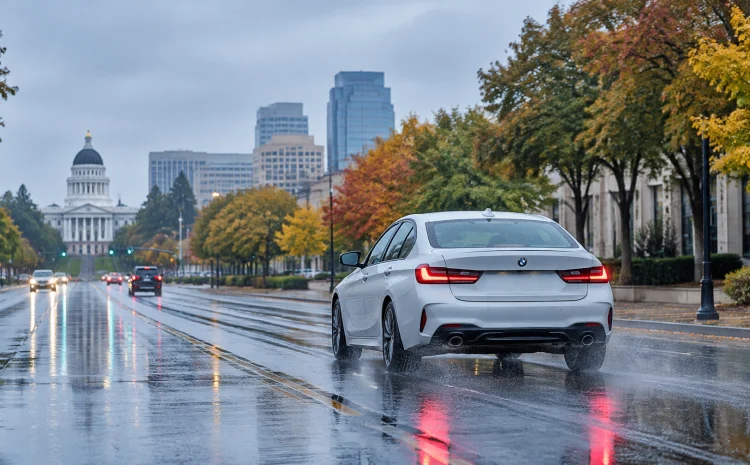
Your First Rain Drive in Months: Why Sacramento’s Wet Roads Are More Dangerous Than You Remember
Sacramento’s first fall rain can make familiar roads feel different. The pavement may look merely damp, but after months of dry weather it can be slick with oil, rubber dust, and grime. Add worn tires, short following distances, and freeway speeds, and a routine drive on I-80 or Highway 50 can become harder to control.
Take it slowly. Check your tires. Leave more room to stop. These simple steps can help you drive with confidence when the rain returns.
Why the first rain can be the slickest
During a long dry spell, oil and other road residue build up on the pavement. When rain begins, water mixes with that residue and can create a slippery film. The risk is often greatest early in a storm, before steady rain has washed some of the surface away.
That does not mean every wet road is equally dangerous. Traction depends on the amount of water, the pavement, your speed, and the condition of your tires. But don’t assume a familiar route is as predictable in the first rain as it was yesterday.
Slow down before curves, intersections, freeway ramps, and areas where water collects. Make gentle steering and braking inputs. Avoid sudden lane changes. Give yourself more time to react, especially in downtown Sacramento traffic, where cars may stop quickly.
Wet roads can increase stopping distance
On wet pavement, your tires have less grip available for braking and steering. You may need substantially more room to stop than you do on dry pavement. Oregon DOT advises drivers that stopping distances can be two to three times longer in wet conditions, though the actual distance depends on speed, tires, water, and other factors.
At freeway speeds, even a small increase in stopping distance matters. If the car ahead brakes suddenly, following too closely leaves little room to respond.
In rain, increase your following distance to at least five or six seconds when conditions allow. Leave more space at higher speeds or in heavy rain. Look well ahead, ease off the accelerator early, and brake smoothly. Avoid cruise control on wet roads so you can respond quickly to changing traction.
Hydroplaning: what it feels like and what to do
Hydroplaning happens when water builds between your tires and the road, reducing or even eliminating tire contact with the pavement. You may feel the steering suddenly go light. The vehicle may drift, slide, or fail to respond normally when you steer.
Speed, water depth, tire pressure, and tread depth all affect the risk. Worn tread has less ability to channel water away from the tire. Driving faster gives water less time to escape from beneath it.
If you think your vehicle is hydroplaning:
- Ease off the accelerator. Let the car slow naturally.
- Do not slam on the brakes. Sudden braking can unsettle the vehicle.
- Steer straight and smoothly. Avoid sharp turns. If you need to change direction, make a gentle adjustment toward where you want to go.
- Wait for traction to return. Then continue at a lower speed.
Don’t use cruise control in rain. And don’t drive through standing water if you can avoid it. You may not know how deep it is, or whether it hides a pothole.
Tread depth matters before a tire looks bald
Tires need tread to move water out of the way. A tire can look acceptable from a quick glance and still have reduced wet-road performance.
Use a tread-depth gauge and check all four tires, including the inner and outer edges. Uneven wear can indicate an alignment or tire-pressure issue. The National Highway Traffic Safety Administration’s tire guidance explains how to check tires and why tread condition matters.
Keep these two measurements in mind:
- Around 4/32 inch: Treat this as a wet-weather warning point. Tires at this depth may have notably less wet-road stopping and handling ability than new tires. Consider replacing them sooner if you regularly drive in rain or at highway speeds.
- At 2/32 inch: This is the commonly used minimum replacement benchmark. Don’t wait until your tires reach it to think about wet-weather safety.
Tire pressure matters, too. Check it when the tires are cold and use the pressure listed on the driver-side door label, not the maximum pressure printed on the tire. The cheapest safety upgrade is a tire-pressure and tread check. It takes little time and can reveal a problem before a storm does.

Make yourself easier to see
Rain reduces visibility for you and for other drivers. Turn on your headlights in rain, even during daylight. Use your low beams, not high beams, which can reflect off rain and make it harder to see. Keep your windshield clean, make sure your wipers clear the glass without streaking, and leave extra space behind larger vehicles that throw up spray.
If visibility becomes too poor to drive safely, pull off the road somewhere safe. Don’t stop in a travel lane or on a narrow shoulder unless you have no safer option. Give yourself time rather than trying to keep up with traffic.
What if your brakes feel different in the wet?
A brief change in brake feel or a light noise after rain can sometimes come from moisture or a thin layer of surface rust on the rotors. Pay attention to whether it clears after a few gentle stops in a safe place.
But don’t dismiss a persistent change. If your brakes grind, pull to one side, vibrate, make a continuing squeal, or the pedal feels soft or sinks, find a safe place to stop and arrange an inspection. A warning light or a sudden loss of braking power deserves immediate attention.
Worn brakes and bald tires are what can turn a scare into a crash. If something feels wrong, don’t wait for the next storm. A brake and tire inspection can help identify the cause before you rely on your vehicle in heavy rain.
Get a clear inspection, not a sales pitch
BMP Auto Service has served Sacramento and surrounding communities since 2010. We began as a European specialist for BMW, Mercedes-Benz, Audi, Porsche, and Land Rover. Today, our ASE-certified technicians work on all makes and models.
We’re a dealership alternative for drivers who want precise service without dealership prices. We source OEM parts directly from vendors and explain what we find before recommending repairs. Ask for measurements and a clear estimate. We believe safety advice should be honest, with no hidden fees or unnecessary upsells.
Our shop is at 7275 32nd Street in North Highlands. We’re a CARFAX Certified Service Shop and BBB Accredited Business, and our work is backed by a 24-month/24,000-mile warranty. Same-day service may be available, and flexible financing through Synchrony can help with eligible repairs.
Before Sacramento’s next downpour, check your tire pressure and tread. Leave more stopping room. If your brakes or tires need attention, contact BMP Auto Service to ask about a free or low-cost inspection. A straightforward check today can help you drive with more peace of mind tomorrow.